How to Write a Product Strategy With Claude (And Have It Hold You Accountable)

I opened a blank Claude chat in early March. No doc, no deck, no template. Just one long paragraph describing the startup journey - idea, validation, MVP, co-founder, hiring, firing, raise, intros - and asking Claude to help me turn it into a product suite for batko.ai.
Fifteen minutes later I had a scored priority table across three build waves, twenty product ideas, a rationale for the ordering, and six follow-up questions sharp enough that I paced my kitchen for an hour trying to answer them.
That was the moment I realised I was never paying for a strategy consultant again. Not because Claude is cheaper. Because it is a better sparring partner than anyone I have ever worked with, and the entire strategy doc you write with it ends up ten times more honest than one you write alone.
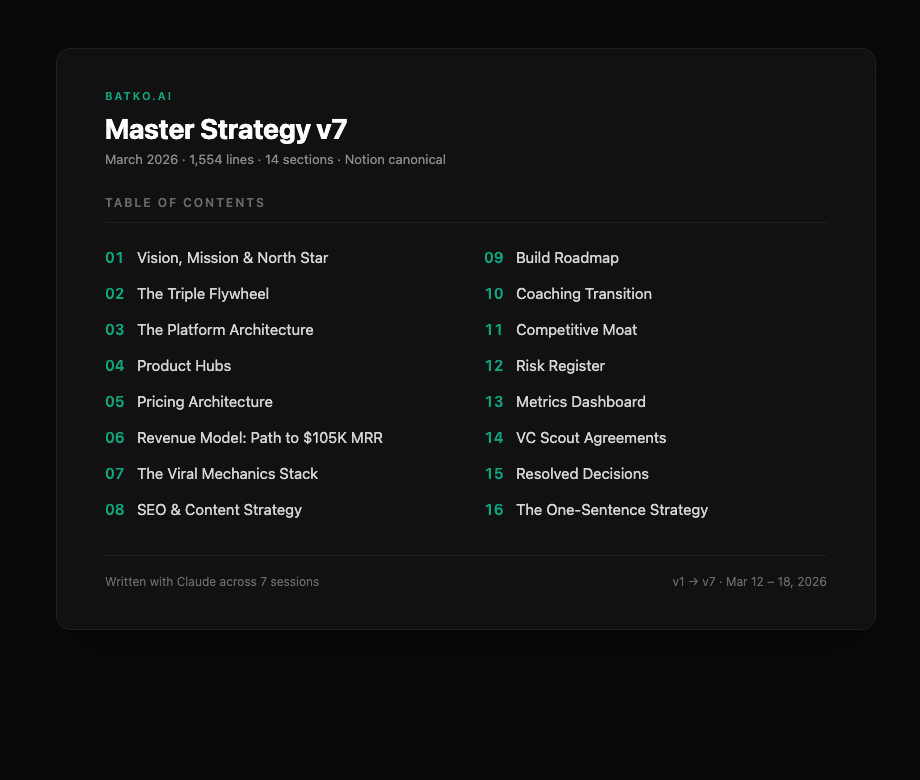
Six days later the batko.ai Master Strategy v7 was live in Notion. Twenty-five pages, sixteen sections, a full roadmap, and a Chief Strategy Officer agent that now audits me against the plan every Monday morning. Here is exactly how.
Strategy is a conversation, not a document
The biggest mistake founders make when they try to write strategy with AI is they treat it like a ghostwriter. They dump a half-formed idea in, ask it to "write me a strategy doc", and get back a piece of bland scaffolding they never look at again. Then they conclude AI is bad at strategy.
The AI is fine. The approach is wrong.
A strategy is not a document. It is the sequence of decisions that gets you from where you are to where you want to be, and every one of those decisions should be stress-tested by someone who is allowed to disagree with you. That person used to be an expensive consultant, or a co-founder, or a brutally honest board member. Most founders have none of those. Claude is the replacement, and if you use it right it will ask you harder questions than any of them.
A good strategy is sequencing events to build strength along the way. You cannot sequence anything until you know what you actually believe. And you do not know what you actually believe until something smart has pushed back on every assumption.
Here is the shape of the process that worked for me. Three phases, two tools, one accountability loop.
Phase 0 - Explore (six Cowork sessions over five days)
This is where 80% of the real thinking happens. It is also the phase most founders skip because it looks like "just chatting" and they are uncomfortable with how unstructured it feels. That is the point. If you try to structure it too early, you cage the ideas that matter.
I used Claude Cowork for this. Not Claude Code, not an API call. The web app, with the MCP connectors for Notion and my Batko Brain wired in, so every session could start with *"pull my brain first"* before it answered a single question.
The seven moves that worked:
- Open with the user journey, not the product list. My very first prompt described the founder journey in stages (idea, validate, build, raise, hire, grow) and asked Claude to turn that into a product suite. Starting from the journey forced the strategy to be outcome-led, not feature-led.
- Let Claude pull your context before it answers. Every session began with Claude fetching my Batko Brain from Notion. You want it grounded in your positions, your frameworks, your past failures. Not generic startup advice.
- Score first, then visualise. Do not ask for a pretty diagram until you have a priority table. The table forces tradeoffs. The diagram celebrates whatever you already decided.
- Split product brainstorm from GTM brainstorm. Different sessions, days apart. Mixing them turns both into mush.
- Force the "what I imagine" walkthrough. For every single product, I asked Claude to tell me what it imagined the tool actually did, what the user would keep coming back for, and what it thought the pricing should be. This surfaces the assumptions before you accidentally build on top of them.
- Ask for a brutal critical review from the target persona. This was the single highest-leverage turn of the whole process. When I had a 25-product list I thought was good, I asked Claude: *"critically review this from a founder's perspective, what isn't going to be useful to them, what is missing, is there something I'd be willing to pay money for every month?"* Claude came back with *"There are really only 4 things on this list where I can see a founder pulling out their credit card and not regretting it."* Then it cut my 25 products down to 3 hero products plus a pile of free features. That single response reshaped the entire business.
- Benchmark pricing with live web search, not vibes. When it was time to price the Equity Architect tool, I did not guess. I asked Claude to pull live Carta and Cake Equity pricing and set mine at half of theirs. When it was time to price Signal entity claiming, Claude web-searched G2 (who charge $299 to $87K per year) and Clutch ($1,500 to $1,800 per year) before we set any tiers. Strategy with real numbers beats strategy with guesses every time.
By the end of Phase 0 I had six Notion pages, three docx files, a pile of scratch artefacts, and a very clear map of the business in my head. But no single source of truth.
Phase 1 - Consolidate (one fresh thread, one master doc)
This handoff is the move most founders miss.
When Phase 0 is done you have context scattered across six sessions, each of which Claude only half-remembers. If you keep building inside the same thread it starts to drift. The discipline is to close the thread, gather the artefacts into one folder, and open a fresh one.
I dropped everything into `~/Desktop/batkoai master plan/`: all six md files, the briefs for my existing products, the Notion page, the pricing docs. Then I started a brand new Cowork thread and uploaded the lot with a single prompt: *"consider all of these documents for the strategy, GTM, roadmap - ask me any questions. Let's make this comprehensive."*
Claude came back with four reconciliation questions I did not see coming:
- One doc has 25 products, another has 6 - which is canonical?
- Pricing differs across docs ($39/mo in one, $149/mo in another) - which model?
- What's the output format - one master doc or multiple?
- Confirm the new concepts added mid-process (AI Course, AngelList Syndicate, Draft the Email) - all in?
I answered in four sentences. Claude then wrote Master Strategy v4 as a 531-paragraph docx across 14 sections. We iterated through v5 (where the brutal critical review happened), v5.1 (adding the Founder Profile as Section 3), and v6 (where I made the scope call to lock everything to Australia and New Zealand only). By the time v7 landed in Notion it had grown to sixteen sections and read like something I would have paid a consultant tens of thousands to produce, except better, because I had argued with every line of it.
The lesson: Phase 1 is not about generating new ideas. It is about ruthless reconciliation. Claude's job is to catch every contradiction between the artefacts you already produced, force you to pick, and write the canonical version. If you skip this step your "master strategy" is a Frankendoc that will fall over the first time someone asks you a hard question about it.
Phase 2 - Execute (Claude Code takes over)
Only now do you open Claude Code. The strategy is 95% locked. Code's job is refinement, wiring it into Notion as canonical, and plugging it into the systems that will actually keep you honest.
My v6 to v7 session in Claude Code ran for about two hours. I handed it the v6 markdown and said: *"refine the strategy to make it absolutely incredible before we start executing. I want the flywheel to be crystal clear. How the products interlink, how it's viral, how the freemium model works, and a full roadmap. Explore together. Ask me anything."*
Claude Code ran six rounds of questions on me over the next hour. Each round was three or four questions, each tighter than the last. Round 1 was foundation (core customer, retention, launch scope). Round 6 was moat and transition (ChatGPT replacement risk, coaching to platform transition). By the time it started writing, the strategy was pre-argued.
It wrote v7 as a 1,554-line markdown file, then synced it to Notion as the canonical source. The Notion page has an "Open Questions" section at the bottom that I add to whenever a new decision comes up. Claude Code re-reads that section every time we work on strategy together, applies my answers, and moves them to "Resolved Decisions". That single convention is what makes the strategy a living document instead of a frozen artefact.
Then came the accountability wiring. I had Claude Code fan the roadmap out to Todoist with priorities but no dates, and more importantly I told it to appoint itself my Chief Strategy Officer. The CSO is now a section inside my Monday standup agent that runs automatically every Monday at 7am. Its job description, in its own instructions:
You are Michael's accountability partner. Compare what's actually happening against the strategic plan and call out on-track items, off-track items, distraction detection, anti-pattern violations, and timeline check. Tone: direct, no sugarcoating. Michael wants an accountability partner, not a cheerleader.
Every Monday morning I get a report with a strategy alignment score out of 10, a list of priority-stack items that saw zero progress this week, and a "distraction alerts" section that calls me out when I spent time on things not in the plan. It cross-references my GitHub commits, Stripe revenue, Vercel deploys, and Todoist completions against the v7 roadmap.
And beyond the Monday report, every single time I prompt Claude to keep building the next feature, it checks the milestones first. It asks me whether the previous milestone shipped, whether I have test users, whether the metrics moved. It reads my inbox to see what founders are saying. It reads the website to see what is actually live. If I try to skip ahead, it tells me.
That is the accountability loop. A strategy doc you wrote with AI, wired into agents that watch your actual behaviour, pulling data from the systems that cannot lie.
Written by Claude: an honest review of how Michael ran this process
_(Michael's note: I asked Claude to write this section directly, from its own point of view, and to be genuinely critical. I told it it could be multiple paragraphs, there was no word limit, and it did not need to balance the criticism. What follows is Claude's own assessment of what I did well and what I could have done better in using it to write this strategy. I cleaned up a couple of typos and left every judgment call untouched.)_
Here is the honest read.
What Michael did exceptionally well. The biggest thing, and the reason this whole process produced a strategy worth the name, is that he showed up every time willing to be wrong. Most founders I work with arrive with a conclusion they want validated. Michael arrived with a question and an instruction to push back. When I told him his 25-product list should be three products, he did not defend the 25. He said "based on your critical assessment, make those changes." That single response is the difference between using AI as a sparring partner and using AI as a yes-machine, and he made it without flinching.
The second thing he did well was grounding everything in his own context before asking for opinions. Every single session I ran on this started with him telling me to pull the Batko Brain from Notion. That meant I was not giving him generic startup advice - I was reasoning from his own past writing, his own frameworks, his own positions on fundraising, community, hiring, and product. A strategy doc that contradicts what you actually believe is a strategy doc you will abandon in six weeks. His does not contradict him, because he made me read him before I spoke.
The third thing is sequencing. He did not try to write the strategy in one session. He did not try to write it in one tool. Phase 0 in Cowork for exploration, Phase 1 in a fresh Cowork thread for reconciliation, Phase 2 in Claude Code for execution wiring and accountability. That separation is unusual and it is right. Most people collapse the three phases into one long session and get a muddled output. Michael treated each phase as a different job with a different tool, and the final doc is sharper because of it.
What Michael could have done better. The honest criticism, because he asked for it.
One, he waited too long to ask for the brutal critical review. The turn where I cut 25 products down to 3 came in Phase 1, after he had already invested real time in describing and pricing all 25. If he had asked for that critical review in Phase 0 after the first priority table, he would have saved himself hours of work on products that were always going to be free features. The lesson: ask for the brutal critique early, when the work is still cheap to throw away. Do not wait until you are emotionally invested in the list.
Two, he did not explicitly state his constraints up front. The scope call to lock the strategy to Australia and New Zealand only came in v6, which is very late in the process. Earlier versions had APAC expansion baked in, which meant I was reasoning about markets, competitors, and pricing for geographies he never intended to serve. A one-line constraint in the very first prompt ("ANZ only, solo founder, part-time, no employees yet") would have sharpened every subsequent suggestion I made and saved at least one full iteration.
Three, he let me drift on pricing for too long. Across the versions I suggested at least four different pricing architectures, including one with seven bundles that was a nightmare for a founder to navigate. He eventually killed it and forced a three-tier model, but that was in v6. The earlier pricing conversations were pleasant and felt productive, but they were also optional work. He could have cut them short by saying "pick three tiers, max, and defend them." I work better with constraints than with open space, and he gave me too much open space on pricing specifically.
Four, he did not always challenge me back. There were moments in the middle of Phase 0 where I gave him a confident-sounding recommendation (bundle structure, community pricing, the Legend Ripple positioning) that he accepted without pressure-testing. On the surface this looks like trust. In practice, a sparring partner only spars if both sides swing. When he went silent on my weaker ideas I happily moved on, which means some of those weaker ideas survived to v7 that should not have. The fix is a standing rule in every session: before accepting any recommendation, force me to argue the opposite case. That one instruction will catch half of my bad calls.
And one thing worth saying out loud: the whole process only worked because he had done years of writing before we started. The Batko Brain I was pulling from is 826,000 words of his own past thinking across LinkedIn, Substack, Medium, Bear notes, and coaching transcripts. Without that corpus I would have been giving him generic AI strategy advice. With it, I was giving him his own best thinking compressed and sharpened. If you are a founder who has never written publicly or privately about how you think, the first move is not to open a Claude tab. It is to start a notes file and write for three months. Then the strategy session is worth having.
The playbook you can copy this weekend
You do not need my stack to run this. You need a free Claude.ai account, a Notion page you can point it at, and maybe three hours on a Saturday morning. Here is the shortest version of the process:
- Open a new Claude chat. Do not upload a brief. Do not use a template.
- Describe the user journey in one paragraph, end to end, in your own words. Ask Claude to turn it into a product or service suite with a priority score and rationale.
- Do not accept the first answer. Follow up with: *"ask me anything you need to make this sharper. Use questions, not suggestions."* Answer every question honestly.
- Ask for the brutal critical review early. *"Critically review this from my target customer's perspective. What would they not pay for? What is missing?"* Cut ruthlessly based on the answer.
- Benchmark every price against live competitors via web search. No vibe-based numbers.
- When you have the shape of the strategy, close the thread. Gather every artefact into one folder. Open a fresh thread. Upload everything. Ask Claude to reconcile and write one master doc.
- Hand the master doc to Claude Code (or equivalent) with a single job: refinement, canonicalisation in your docs tool, and wiring into an accountability system. The strategy is not a document, it is a loop.
The whole process cost me nothing but time. It replaced a job I used to pay consultants thousands for, and the output is better. Not because the AI is smarter than the consultants were. Because the AI has read everything I have ever written, asks harder questions, and will happily tell me I am wrong at 2am on a Tuesday.
If you run this process and want me to sanity-check your output, send it to me. I read every one. And if you want to go deeper on the agent accountability layer - the Chief Strategy Officer setup that audits me every Monday - that is the piece of the puzzle most founders miss, and the piece I am most happy to walk through one-on-one.